

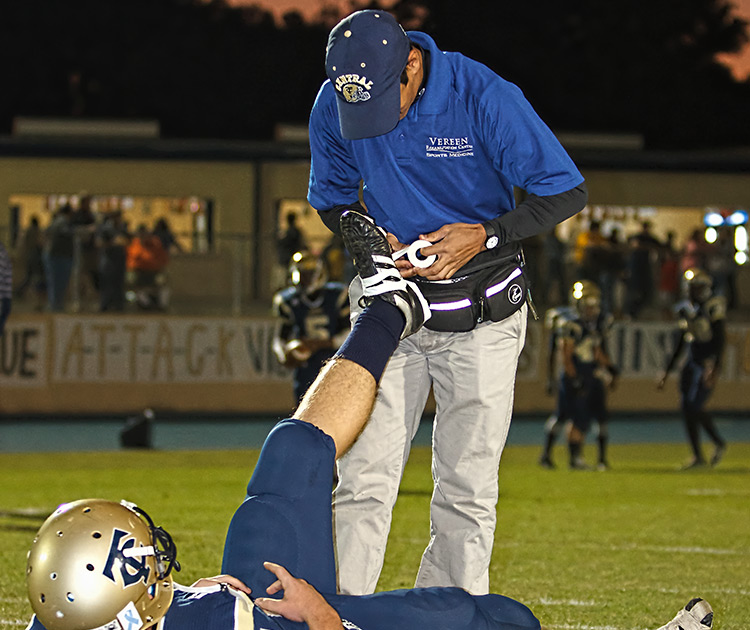
Imagine you’re in the biggest game of your life. The entire school is depending on you, the star, to carry the team to victory in what has been touted as the most important game in school history. You start off on a tear, opening up a huge lead; however, as the game nears crunch time, your crosstown rivals manage to close the gap and make it a contest late. And then, to complete surprise, the worst happens: your knee gives way, and you go toppling to the ground.
Your team manages to hold on to win, but now you’re on crutches. Luckily, your injury is not severe; thankfully, the biggest reason that your injury wasn’t worse was due to the swift and effective efforts of your school’s athletic trainer. The trainer was able to quickly diagnose the problem and provide care before more attention could be provided.
March is National Athletic Training Month, and in celebration, In the Game Magazine has taken the time to recognize these unsung heroes and educate our readers as to what exactly an athletic trainer does. Perhaps the most important distinction to make known in regards to athletic trainers? They are NOT the same as “personal trainers”. Their jobs and daily expectations differ greatly.
At a minimum, athletic trainers:
- Provide physical medicine, as well as preventative and rehabilitation services
- Treat a wide variety of patients, including (but not limited to) professional, college, and secondary school athletes, as well as youth athletes, dancers, musicians, and military personnel
- Work in a variety of locations, including schools, clinics, hospitals, and manufacturing plants (among others)
- Prevent, diagnose, and treat acute and chronic injuries
- Coordinate care with physicians and other health care professionals
The key difference of note is the fact that while personal trainers are apt to educate masses on the importance of getting or staying in shape, athletic trainers are more adequately prepared to tend to those in need once injuries actually occur. This is also reflected in their respective levels of training. Athletic trainers are required to earn, at minimum, a bachelor’s degree in their field. They must also pass a comprehensive exam in order to earn credentials with the ATC (Athletic Trainer, Certified) credential. Furthermore, athletic trainers must regularly participate in continuing education in order to keep their knowledge and skills current, while also adhering to standards set by a national certifying agency and to a national code of ethics. Personal trainers may or may not have higher education or certification, or participation in continuing education.
Whether you’re an athlete, a parent, or a fan, chances are that you have either seen or crossed paths with an athletic trainer. The next time you see one of them, make sure to thank them for all of their efforts. What they do behind the scenes makes it possible to enjoy what you see on the field of competition at institutions all over the world.
South Georgia / March 2016
National Athletic Trainers’ Association
National Athletic Training Month: It’s Nothing “Personal”
By James Washington