

6 National Championships, Record Crowds, and a Legacy That Stands Unmatched in Amateur Slow Pitch Softball
Humble Beginnings of a Dynasty
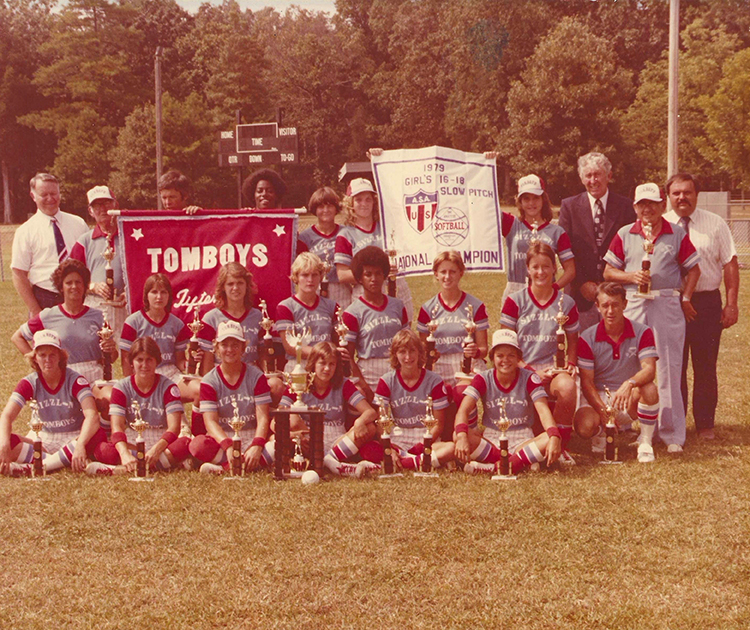
When Tommy and Carolyn Cottle decided to launch a girls softball team in their hometown of Tifton, Georgia, in 1975, they could not have imagined that this group of local little leaguers would become a nationally known championship team that would draw crowds of thousands from Tifton to Idaho.
The team was known as the Tifton Tomboys, and from 1976 to 1987 they ruled the world of girls and women’s youth slow pitch softball, winning six national titles and becoming a true sports dynasty in the history of amateur slow pitch softball. They are considered perhaps the most successful amateur girls softball franchise in the history of the Amateur Softball Association, softball’s chief governing body.

The Tomboys began from humble beginnings.
Tommy Cottle was a Tifton insurance salesman and sports enthusiast who began coaching his wife’s adult team before turning his attention to his daughter’s team.
His daughter, Darby Veazey, recalled the early days of the Tomboys and how it all began.
“My father was coaching my mama’s softball team prior to the two of them starting the youth team,” said Veazey, who became the standout shortstop of the Tomboys and was the face of the team for years.
According to Veazey, that was in 1974, and she was part of a recreation All-Star team that her parents started coaching.
The Cottles recruited the help of a third coach, Gerald “Murt” Melton, who soon joined the team.
The next year, in 1975, the Tomboys were a group of 12-year-olds who became members of the Little League Association and played in its first Little League national tournament in Satellite Beach, Florida, with the help of Tifton Recreation League director EB Hamilton, who also served as an administrator for Little League Baseball.
The Tomboys placed sixth in the tournament, which was an early indication that the team was something special.
After seeing how well the Tomboys placed in the Satellite Beach national tournament, Hamilton looked into having the team join the ASA.
“Mr. Hamilton recruited Bobby Simpson – Simpson worked with Hamilton in the Tifton Recreation Department – to help get the ball rolling with the ASA,” Veazey said.
1976 National Championship: Coming Back to Win 7 Straight
In 1976, the ASA hosted its national tournament in Coeur d’Alene, Idaho. Teams had to qualify for the tournament, which the Tomboys did. The tournament included 36 teams from around the country.
Veazey remembered the Idaho tournament and how things got off to a rough start for the Tomboys.
“It was a double elimination bracket, and we lost early on,” she said.
She said the team quickly became a favorite of the locals.
“We picked up a lot of local fans throughout the tournament, and they started pulling for us,” she said. “The stands were packed as we continued to play game after game, and we kept winning.
“We had to come back and win seven straight games to win the national title.”
The Tifton Tomboys were national champions.
Veazey said the town celebrated as if the Tifton team was one of their own.
“A local restaurant owner opened up his restaurant and cooked a celebration steak dinner for us,” she said.
Of all the memories of that final day, as the team played game after game on Sunday, Veazey said the standout was the team’s pitcher.
“Our main pitcher, Gail Dowler, was a diabetic, and how she played that many games, I will never know,” Veazey said.
The local radio station in Tifton had made the trip to Idaho and was broadcasting the games live back to the hometown fans. Everyone was aware of the Tomboys’ national championship win and was waiting for the team when they returned home.
“When we got back to the Tift County line on I-75, we were met by the Georgia State Patrol, who escorted us back to the ball park for a closing ceremony, where much of the town turned out,” Veazey said.
Tifton Hosts 1977 National Tournament, Sees Record Crowd of 7,000
Winning the national title had not only put the Tomboys on the map, but had given Tifton an opportunity to host a tournament of its own.
Local recreation staff traveled to San Diego, California, for the ASA national meeting to bid for the 1977 Girls Slow Pitch Softball National Championship tournament, and they won the bid, making Tifton the host city for the next national tournament.
Forty-three teams and their fans from across the country descended on Tifton for the 1977 15-under ASA National Softball Tournament.
Once again, the Tomboys found themselves at the center of the national amateur women’s softball world, but this time on their home turf.
The Tomboys played their way into the championship game against a team from Bellevue, Washington, on a bright, sunny Sunday afternoon.
“The bleachers around the park were completely full, and people were lined up two-deep around the outfield fence,” Veazey said. “There were people sitting on the neighboring fire station’s rooftop watching the game.”
The crowd was estimated at around 7,000 that day to watch the Tomboys claim a second straight ASA national championship. According to a 1992 story in Balls and Strikes, a softball publication, the crowd in Tifton that day set the all-time single-day attendance record.
“That was truly a defining moment for the Tomboys,” Veazey said.
From Youth Softball to Women’s Major League
As the players grew from young girls to young women, the team continued to advance into the next age bracket, from 13-15 years old, to 16-18, then on to 19-and-over, which put them into the women’s major softball league.
6th and Final Championship: 1986 in Parma, Ohio
The Tomboys’ final national championship came in 1986 in Parma, Ohio.
“I’ll never forget that national tournament in 1986 in Parma, Ohio, where we won it 2-1 in the bottom of the seventh inning on a bang-bang play at the plate,” Veazey said.
That marked the sixth national championship for the Tomboys.
With most of the team’s members now in their early 20s and busy with getting on with their lives, including getting married and playing college softball, Tommy and Carolyn Cottle thought the time might be right to bring an end to the Tomboys.
“I remember my father and I were at the hotel after the game, and he looked at me and asked if I was ready to hang it up,” Veazey said. “He said, ‘I’ll do whatever you want to do.'”
Veazey had gotten married the previous year and was also playing college softball with the Florida State Seminoles.
It would have been easy to call it a career with the Tomboys, but like most competitors, which Veazey certainly was, she was not quite ready to stop. Even though the team had won the championship, Veazey said by her own standards she was not completely happy with how she had played.
“I did not have a good tournament, and I told my father that I wanted to come back one more time so that I could go out feeling good about my performance and hang up my cleats with no regrets,” she said.
But more important was the camaraderie she shared with her teammates, something she was not ready to walk away from.
“There is something special about the people you compete with, the sweat and grind we all shared to reach a common goal,” she said. “The relationships and friendships that were fostered over the years with all of us meant more than the trophies and accolades. When you practice twice a day with your teammates in the heat of the summer and feel like you work harder than the other teams, it’s tough to just walk away from that.”
The team came back in 1987, and although the Tomboys did not win a national championship, Veazey said she and her teammates had a great tournament.
“After that, we retired for good with no regrets,” Veazey said.
“My parents and Coach Melton’s vision was always to be the best we could be, but I think the magnitude of it just evolved. The goal was to always win the national championship, and he always preached that it was harder to stay on top than it was to get there.”
Tomboys’ College Softball Legacy
In addition to Veazey’s career at Florida State, many of the Tomboys went on to play collegiate softball, including Kelly Tillman, Nancy Mark, Sharon Mancil, Leann Inlow, Susan Painter, Charlotte Cates, Sunnie O’Neal, Missy Cromer, Linda Jones, Lisa Robinson, Selena Woodall, Libby Parrish, Angela Keen, Sue Lanier, Joann Sirmans, Dee Ann Young, and Sharri Melton Knight.